The Project Hysteria in Digital Transformation
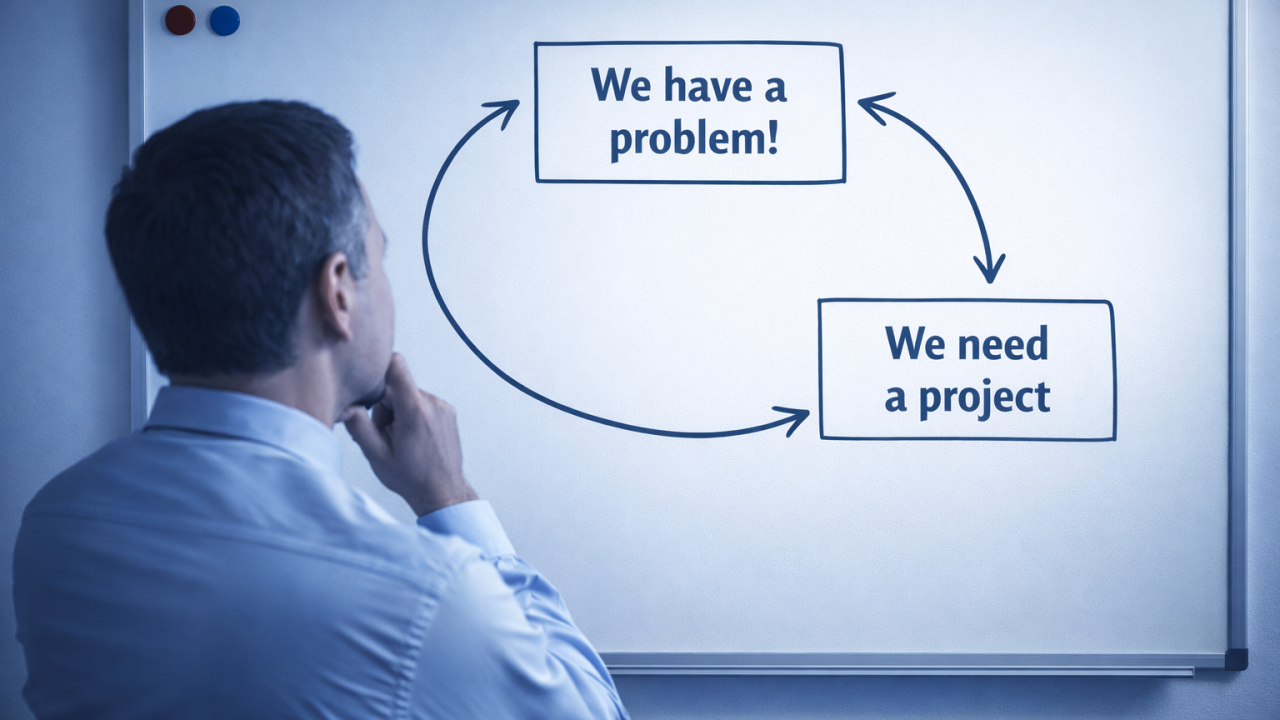
Every few years, a new wave of “digital transformation” sweeps through organisations. Markets shift, customer expectations evolve, and technology opens new possibilities. The response inside most enterprises is remarkably consistent: a programme is defined, workstreams are launched, a transformation lead is appointed, and progress is tracked through structured milestones and steering committees.
On the surface, this appears responsible. Change is formalised, governed and measured. Yet despite this effort, many digital transformation projects underperform, stall quietly, or deliver less impact than anticipated. The recurring disappointment is rarely caused by lack of competence or ambition. It stems from something deeper.
Why organisations default to projects
Projects offer psychological comfort. They create boundaries around uncertainty and translate ambiguity into manageable scope. A project has a start and an end, a defined budget, assigned accountability and measurable deliverables. It turns change into something finite.
In stable environments, this model works well. A system is replaced, a process is optimised, a capability is introduced. The project concludes, and the organisation continues operating on an updated baseline.
Digital transformation, however, is not a finite capability shift. It is an ongoing reconfiguration of how value is created, captured and sustained. Treating it as a temporary initiative misunderstands its nature. When continuous adaptation is organised as episodic intervention, the organisation remains structurally unchanged.
Projects externalise learning
When transformation is organised through projects, learning is often separated from the operating core. A temporary team is assembled, a dedicated budget is allocated, and governance is adapted just enough to allow the initiative to proceed. Progress is tracked against predefined objectives, often defined before reality has fully revealed itself.
In effect, the organisation attempts to change itself through a structure that exists beside it rather than within it.
When the project concludes, the temporary structure dissolves. The team disbands, reporting lines revert, and capital is reassigned. Unless the underlying mechanisms of decision-making, capital allocation and accountability have been redesigned, the organisation’s behavioural patterns remain intact. The initiative may have produced outputs, but the architecture that shapes behaviour remains the same.
Over time, old patterns resurface, not because people resist change, but because the system rewards familiar behaviour.
The illusion of momentum
Project dashboards provide visibility. Milestones are achieved, budgets are consumed, dependencies are managed and risks are mitigated. From a governance perspective, the transformation appears to be under control.
However, activity should not be confused with adaptation.
Adaptation requires that decision authority sits close to value creation, that feedback loops remain continuous, and that capital can move when assumptions prove incorrect. It requires embedded ownership rather than delegated responsibility. Most project structures optimise execution within existing constraints rather than questioning whether those constraints still serve the organisation’s purpose.
The result is often incremental progress without structural evolution.
Why change projects frequently disappoint
Change projects do not fail because change is inherently difficult. They fail because they attempt to introduce new behaviours into an unchanged governance architecture.
Leadership announces agility, yet approval structures remain hierarchical. Teams are encouraged to take ownership, yet strategic decisions are centralised. Innovation is promoted, yet funding is fixed in annual cycles that limit responsiveness.
In such environments, the project may deliver artefacts — new tools, new processes, new terminology — but the underlying economic logic of the organisation remains intact. Decision rights, capital flows and accountability structures continue to reinforce previous patterns.
Over time, the initiative fades, not due to resistance, but due to architectural gravity.
The economic consequences of project thinking
Project thinking assumes that change can be scoped, predicted and delivered within bounded investment cycles. It assumes that ownership can be temporarily assigned and later reabsorbed. It assumes that value can be forecast with sufficient precision to justify upfront allocation.
Digital environments behave differently. Assumptions decay quickly. Value emerges through iteration and learning rather than linear execution. Competitive advantage compounds when organisations adapt continuously, not episodically.
When transformation is organised through projects, capital becomes rigid. Reallocation is politically sensitive. Stopping an initiative is more difficult than starting one. Learning becomes constrained by sunk cost.
The hidden cost is not the visible failure of a project. It is the loss of optionality and the gradual erosion of adaptability.
Beyond project governance
This does not imply that projects are inherently flawed. They remain effective instruments for delivering defined change. The problem arises when structural challenges are addressed with temporary tools.
Sustainable digital transformation requires a shift from project governance to what might be described as digital governance: a model in which decision rights are explicit, authority is placed close to value creation, and capital allocation mechanisms are designed for movement rather than rigidity.
Transformation becomes durable when the organisation redesigns how decisions are formed, how investments are prioritised, and how accountability is distributed. In such systems, change is not an initiative layered on top of the business; it is a capability embedded within it.
A structural conclusion
As long as organisations continue to approach digital transformation primarily through projects, they will experience cycles of enthusiasm, activity and regression. Real transformation begins not with a programme, but with a redesign of the structures that shape economic behaviour.